
Associate Professor Kevin Clarno will lead a team of eight UT Austin researchers as part of a national effort using AI and digital twins to accelerate nuclear energy development.
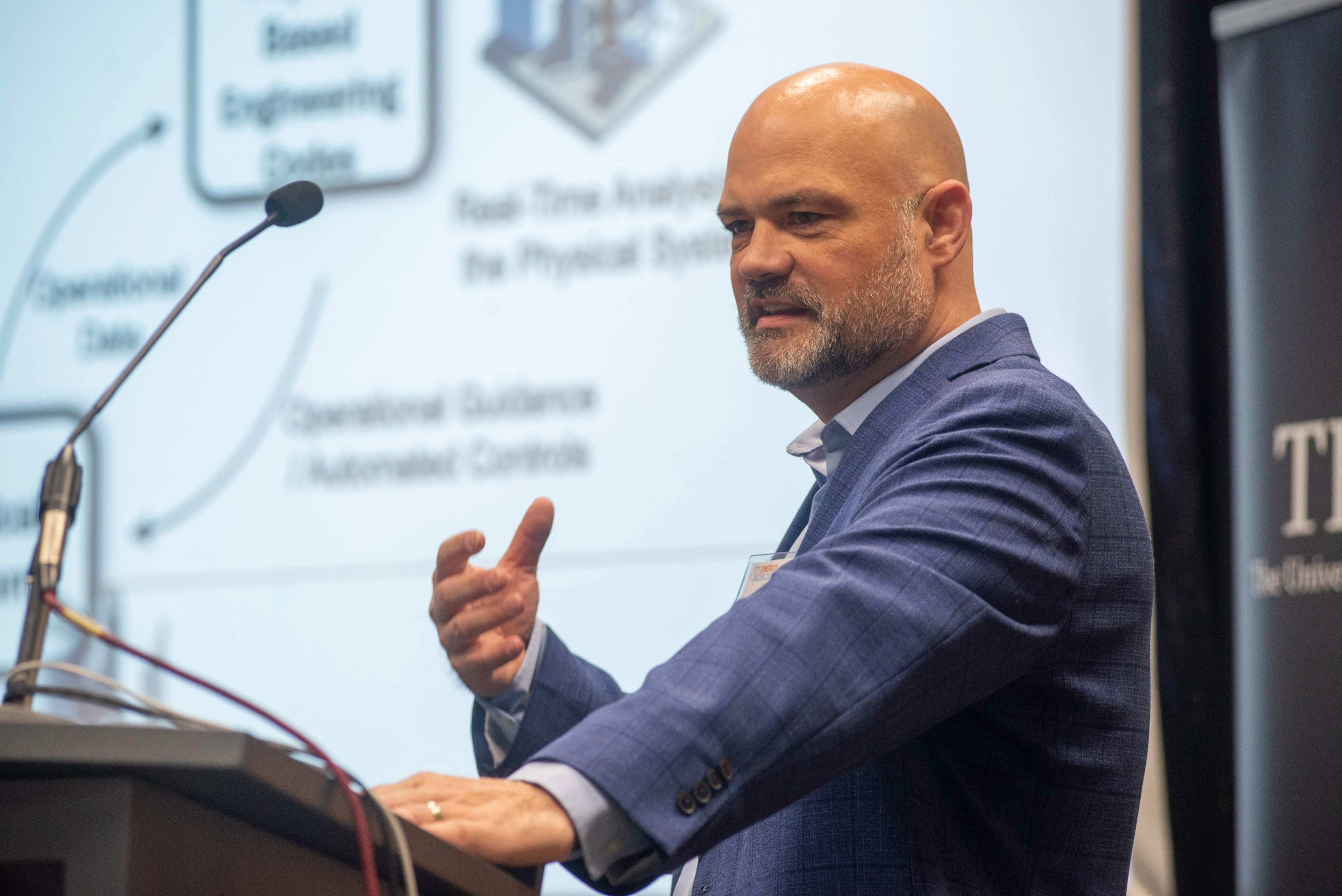
Kevin Clarno, associate professor in The University of Texas at Austin's Walker Department of Mechanical Engineering and core faculty member with the Oden Institute for Computational Engineering and Sciences, has received funding through the U.S. Department of Energy’s (DOE) Genesis Mission to advance artificial intelligence and digital twin technologies that can better predict and understand what occurs inside nuclear reactors.
Clarno will lead a team of eight UT Austin researchers as part of Prometheus, a $60 million initiative led by Idaho National Laboratory (INL) focused on reducing the time and cost required to design, license, construct and operate advanced nuclear energy systems. In collaboration with INL, Oak Ridge National Laboratory, Argonne National Laboratory, Sandia National Laboratories, universities and more than 20 industry leaders, the team will contribute to a national effort to modernize nuclear energy development and apply AI across the entire nuclear reactor lifecycle.
“The nuclear industry is up against a huge challenge: Building reactors is expensive and time-consuming, and the demand for reliable energy is ever-growing,” said Clarno. “I’m pleased that the Genesis Mission is tackling this problem and opening the door for accelerated scientific research and innovation that will help us continue to advance the next generation of reactors.”
With the Genesis Mission funding, UT researchers will integrate real-time data from the University’s Nuclear Engineering Teaching Laboratory (NETL) TRIGA Mark II research reactor — one of the nation’s most heavily utilized university research reactors — into the Prometheus platform. Associate Professor William Charlton, Director of NETL, will oversee the integration of AI infrastructure within the control room environment, trained using advanced computational models that simulate the reactor behavior by leveraging the Texas Advanced Computing Center's (TACC) Lonestar6 supercomputing resources. In providing this technology, UT will support the creation of nuclear energy systems that are safer, more efficient and more affordable, and provide practical demonstration of autonomous operation of a nuclear reactor.
This research will build on momentum from the Texas Nuclear Digital Twin Program, a State of Texas-funded project directed by Clarno and Associate Professor Derek Haas. The program develops virtual models using real-time data that are integrated with physical systems, including the TRIGA reactor. Clarno and his team develop computational tools that improve the monitoring, prediction and operation of nuclear reactors. Prometheus will expand the reach of UT’s digital twin research, enabling it to move beyond individual research projects and make it a national collaborative platform for advanced nuclear technologies.
Through Prometheus, students and postdoctoral researchers will gain hands-on training alongside national laboratory and industry collaborators, shaping the next generation of nuclear engineers. This effort also strengthens UT's role in the DOE's growing digital engineering ecosystem and positions the University as a leader in applying AI, advanced computing and engineering science to real-world energy solutions.
